
About > Organizational Members
Concept Note: Visionary Learning through Technology
Vision
Students with visual impairment are empowered through accessible technology to learn, communicate, and participate alongside their sighted classmates at school, in higher education, and into employment.
The Issues
The Lancet Global Health Commission on Global Eye Health reports that among children aged 0–14 years, there are an estimated 1.4 million children who are blind, 22.6 million with moderate to severe visual impairment, and 46.6 million with mild visual impairment (Burton, Ramke et al., 2021).
The World Health Organization and UNICEF (2022) estimate that over 2.5 billion people would benefit from one or more assistive products.
For many children with visual impairment, learning materials do not exist in accessible formats such as braille, audio, or large print. Imagine trying to learn in a classroom where you cannot read the textbooks, see the whiteboard, or write your assignments. Lack of access to reading and writing tools closes the doorway to education and, ultimately, to employment.
Technology and the internet are transforming education globally. Low-cost smartphones, tablets, computers, video magnifiers, and digital braille devices make it possible to access books and information in the format each learner prefers. Textbooks and other materials can be digitised so they become accessible; publishers can ensure that future titles are born accessible as standard practice.
Strategic Alignment
This initiative aligns with:
- Sustainable Development Goal 4: Inclusive and equitable education for all
- UN Convention on the Rights of Persons with Disabilities (2006)
- Incheon Declaration and Education 2030 Agenda
The Visionary Learning initiative also supports countries implementing the Marrakesh Treaty (2013) by enabling accessible publishing and cross-border exchange of accessible books through national copyright exceptions.
What we want to achieve
“Access to assistive technology for children with disabilities is often the first step for childhood development, access to education, participation in sports and civic life, and getting ready for employment” (WHO & UNICEF, 2022, p. ix).
The Visionary Learning through Technology initiative will increase access to books in alternative formats and support the provision and training in mainstream and assistive reading and writing devices in selected partner countries. It builds on the success of the Visionary Learning initiative in the ICEVI Africa region, which demonstrated that accessible technology and digital skills training change educational outcomes for students with visual impairment.
Building on what works: The Five Elements
Kit – “A device I can use”
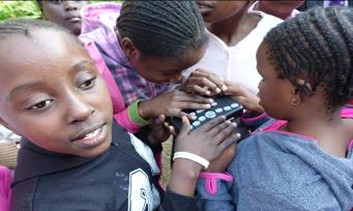
Once a child has suitable reading and writing technology and internet access, the world of learning opens. Devices may include a smartphone, tablet, laptop, portable audio player, or digital braille device. Text may be enlarged, spoken aloud, or displayed on a refreshable braille display. With the right device, each learner can read and write independently and complete their schoolwork alongside sighted peers.
Confidence – “Skills that help me learn”
Students build confidence by mastering the skills needed to connect with information through accessible technology. Parents, teachers, and publishers will receive training so they can empower children and support literacy development. A “train-the-trainer” model ensures knowledge is sustained and shared across schools and regions.
Content – “Books I can read”
Reading is the gateway to literacy and learning. Very few textbooks exist in audio, braille, or large print. When books and teaching resources are available in accessible digital formats and local languages, students can read independently using their chosen device. This initiative will increase the number of accessible books and build capacity among teachers and publishers to produce accessible materials.
Connection – “I belong”
Connection to learning requires more than supplying a device. Books and curriculum materials may reach a child via a memory card delivered by motorbike, or by accessing digital libraries through the internet. When students have the right device, accessible content, and the skills to use them, they feel seen, included, and part of the classroom community.
Providing a child with the right “kit” and “content”, combined with “confidence” through skill development, also brings a sense of belonging – a sense of being seen, heard, valued, and included. The child’s connection with teachers, classmates, and the curriculum in facilitated by enabling learning environments, that is, environments where the principles of universal design, inclusivity and accessibility are fundamental to the school culture, policies and practices.
Culture – “Who I am and what I influence”
Children thrive in environments where accessibility and inclusion are fundamental. Access to technology and culturally relevant reading materials in a child’s preferred language and format helps build identity, confidence, and meaningful participation in community and society.
Global Initiative
Visionary Learning through Technology is an innovative, scalable initiative that adapts to local needs, is grounded in evidence, and informed by evaluation. ICEVI and the DAISY Consortium will partner with international, regional, and local organisations including government ministries, schools, organisations of people with disabilities, technology companies, the World Blind Union, and the WIPO Accessible Books Consortium.
Collaboration with the Accessible Books Consortium and Benetech Bookshare will maximise access to thousands of books in global repositories. Engagement with publishers and rightsholders will grow the number of materials that are born accessible.
Potential Activities
Collaborate for systemic change:
- Demonstrate the transformative impact of technology on learning to influence government policy and investment.
- Convene national stakeholder forums to build shared commitment and drive policy change.
Build capacity and local education delivery:
- Train teachers, publishers, schools, and universities in the use of accessible technology and accessible publishing practices.
- Collaborate with WIPO ABC, Benetech, and local partners to train stakeholders in accessible digital textbook production and connect local libraries to the Accessible Books Consortium and Bookshare repositories.
Direct support to students:
- Partner with development organisations to provide devices, training, and ongoing support to students with visual impairment.
Partners
This initiative is led by:
- International Council for Education of People with Visual Impairment (ICEVI): Promoting access to inclusive, equitable, and quality education for all people with visual impairment.
- DAISY Consortium: A global network of over 150 organisations working to ensure equal access to information and knowledge.
Conclusion
“Access to appropriate, quality assistive technology can mean the difference between enabling or denying education for a child, participation in the workforce for an adult, or the opportunity to maintain independence and age with dignity for an older person.”
With accessible books and technology, students with visual impairment can learn, progress, and contribute to society on an equal basis with their peers. In high-income countries, technology has already transformed education for these learners. Now is the time to extend these opportunities to children in low- and middle-income countries.
Visionary Learning through Technology — Kit, Confidence, Content, Connection, and Culture — empowers students and teachers to achieve inclusive and equitable quality education for all. When students open a book, they open the door to opportunity.
Definitions:
- Visual impairment: Umbrella term including blindness, low vision/partial sight, deafblindness, and multiple disability with visual impairment (MDVI).
- Information and Communication Technologies (ICTs): Tools used to store, transmit or exchange information, including computers, the internet, broadcasting tools, and mobile technologies (UNESCO, 2023).
- Assistive technology: Assistive products and related systems and services (WHO & UNICEF, 2022).
- Born accessible: Publications designed from the outset to be accessible to people with disabilities.
- Mainstream accessible technology: Commonly used technology (smartphones, websites, digital publications) with built-in accessibility features.
References:
Burton, M.J., Ramke, J., Marques, A.P., Bourne, R.R.A., Congdon N., Jones I., et al. (2021, April). The Lancet Global Health Commission on Global Eye Health: Vision beyond 2020. The Lancet Global Health, 9(4), 489–551. https://www.iapb.org/learn/vision-atlas/magnitude-and-projections/child-eye-health/
World Health Organization and UNICEF. (2022). Global report on assistive technology. https://www.who.int/publications/i/item/9789240049451